BE-IIS-HPP-2T1L
A four-port 10BASE-T1L HAT++ switch platform for building and evaluating larger Single Pair Ethernet networks.

Required platform: 64-bit Raspberry Pi OS
Using another operating system is technically possible, but the missing driver cannot simply be built as an external module. Use a matching 64-bit Raspberry Pi OS kernel, or rebuild and use a kernel that includes the required driver module before installing the HAT software.
Overview
The BE-IIS-HPP-2T1L combines two Analog Devices ADIN2111 two-port Ethernet switch devices. It provides four 10BASE-T1L ports for Raspberry Pi based evaluation systems, daisy-chain experiments and industrial network prototypes.
The board is designed as a HAT++ product. Its instance selection supports predictable use in a larger stack and avoids conflicts with other SPI-based boards.
Ethernet topology
Each ADIN2111 contributes two physical T1L ports. This makes the HAT suitable for small switched network structures, line topologies and evaluation of forwarding between multiple single-pair links.
The product is particularly useful when a project needs more than one T1L segment but should still be controlled by one Raspberry Pi system.
Linux integration
The BE-IIS installer contains the product-specific overlays, descriptors and software integration for instance modes I, II and III. The switch devices are exposed through the ADIN1110-family driver integration.
Persistent udev rules distinguish physical switch ports. Typical port names follow the beiis-t1l* convention and map the SPI instance and physical port to stable Linux interface names.
Integration notes
Use the product-specific overlay that matches the selected instance. A switched T1L design still requires correct termination and a valid point-to-point link for every individual cable segment.
Inspecting switch ports
After the product overlay and driver are active, verify that Linux has created the expected persistent T1L interfaces before configuring addresses or bridges.
ip -br link | grep beiis-t1l
ip link show beiis-t1l0
ip link show beiis-t1l3
The interface names identify the selected SPI instance and the physical switch port. For example, instance I uses beiis-t1l0 and beiis-t1l3; later instances use the next matching pair of names.
T1L / T1S media converter
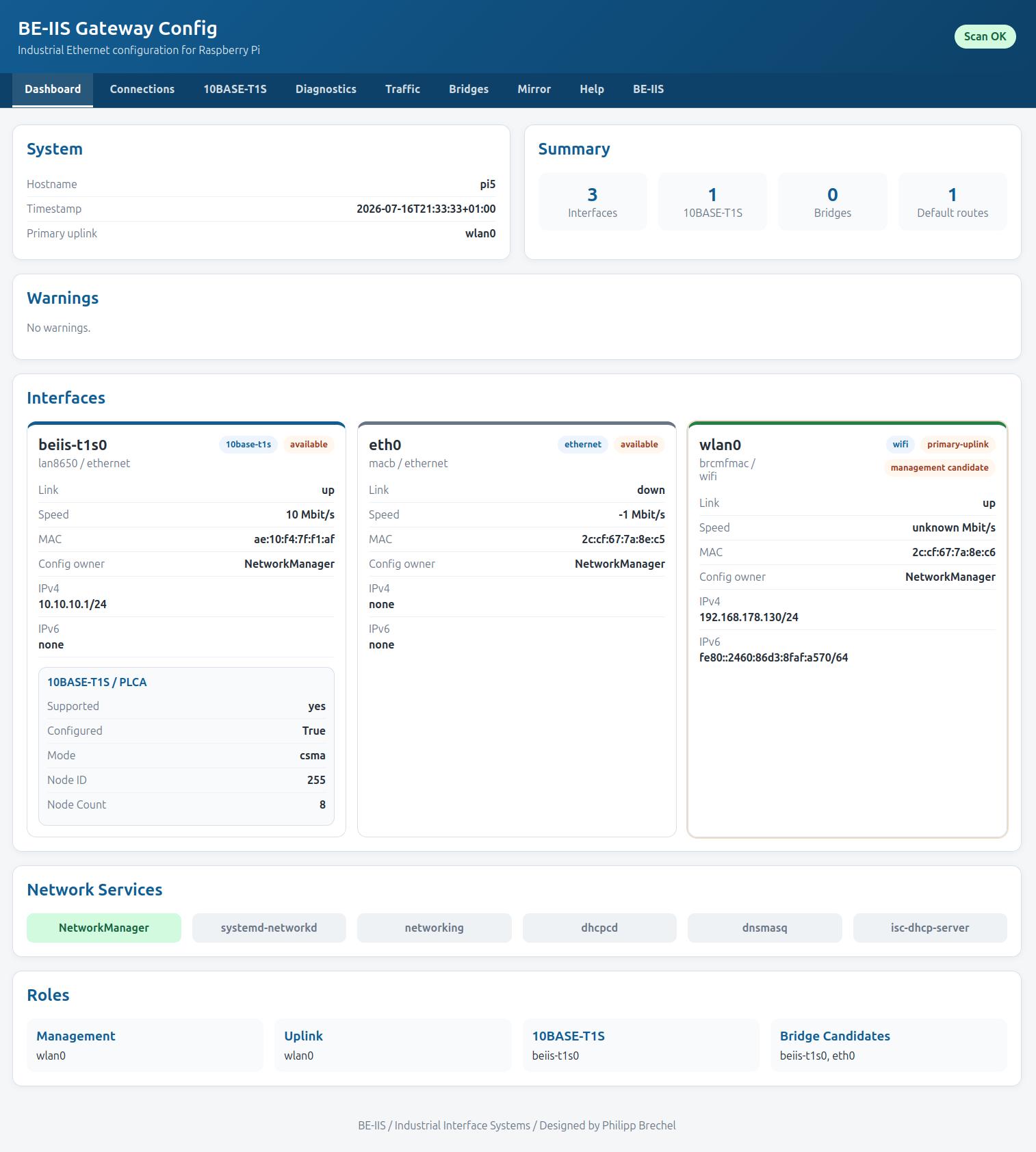
A BE-IIS T1L, T1S or 2T1L HAT can be used with the BE-IIS LAN HAT as a transparent Layer-2 media converter between conventional Ethernet and Single Pair Ethernet. The web interface configures the bridge and makes link, PLCA and traffic diagnostics visible. It is Ethernet bridging, not CAN or Modbus protocol conversion.
The T1L/T1S interface converter application explains the complete setup. The implementation and web interface are available in the BE-IIS Network Web repository.