BE-IIS-HPP-PoSPE
A HAT++ add-on for supplying power over Single Pair Ethernet without changing the Ethernet interface configuration.
Overview
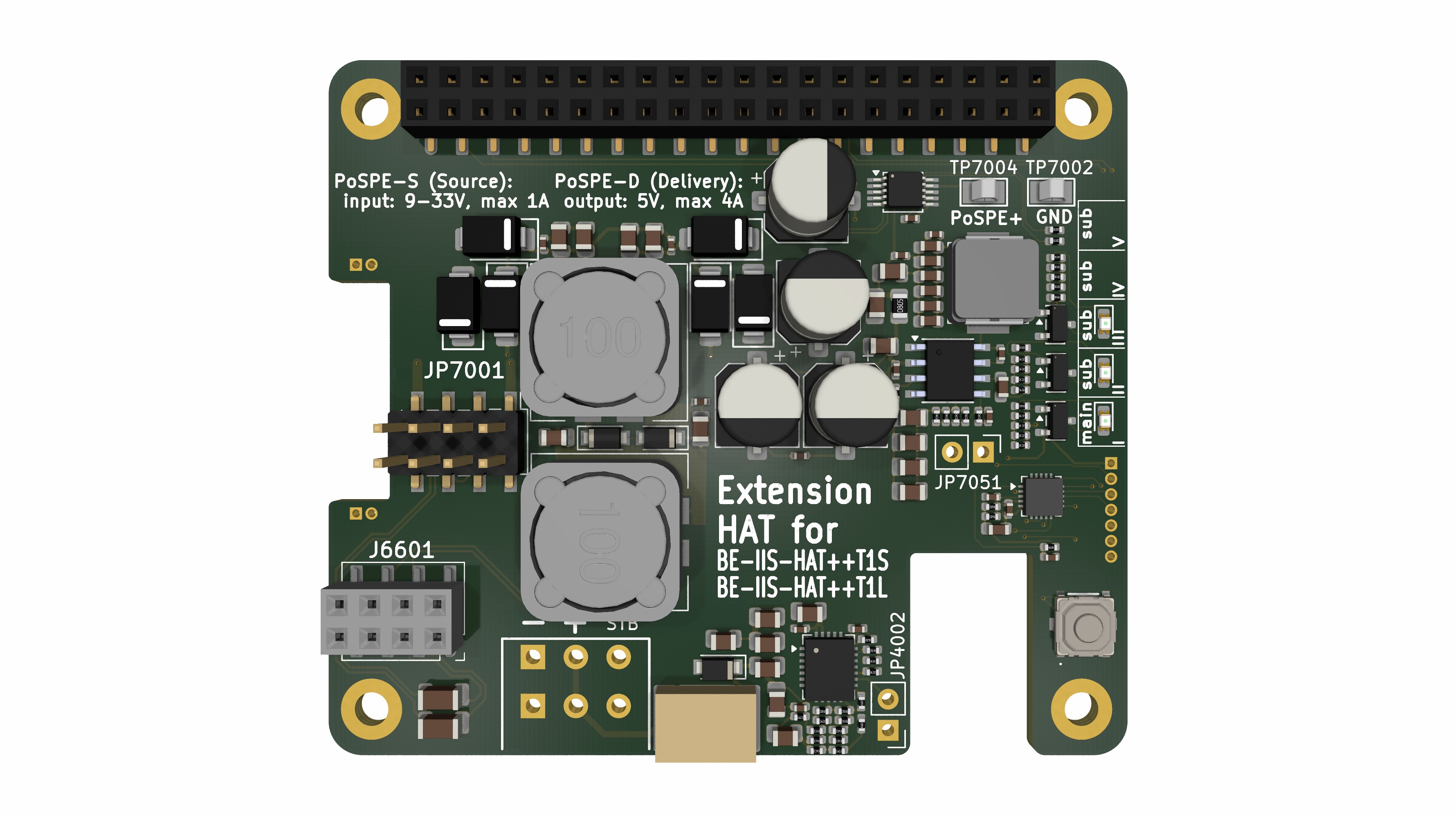
The BE-IIS-HPP-PoSPE adds Power over Single Pair Ethernet capability to compatible BE-IIS 10BASE-T1L and 10BASE-T1S systems. It is an electrical power-delivery add-on rather than a separate Linux interface.
The board is transparent to the HAT++ software architecture. It does not consume an SPI chip select, create an Ethernet device or change the Device Tree configuration of the communication HAT.
System role
PoSPE allows a system to combine communication and remote power delivery on the same SPE cable. This is useful for field nodes, remote Raspberry Pi systems and compact evaluation installations.
The installer examples include a field-switch setup where a remote Raspberry Pi is powered over a 10BASE-T1L connection and forwards the supplied power to another system.
Integration notes
Plan the power architecture before connecting hardware:
- confirm that the selected Ethernet HAT and PoSPE arrangement are compatible
- respect the permitted voltage and current range of every board and cable
- ensure correct polarity and safe wiring
- consider voltage drop for long cable runs
PoSPE has no separate software setup. Configure the associated T1L or T1S network interface as usual.
Field-switch bridge example
PoSPE itself does not create a Linux device. The associated SPE HAT is configured normally. The field-switch example bridges a T1L and T1S interface after the remote system is powered through the T1L connection.
sudo ip link add br0 type bridge
sudo ip link set beiis-t1l1 master br0
sudo ip link set beiis-t1s0 master br0
sudo ip link set br0 up
This example is only the network part of the system. Verify the electrical supply path and permitted voltage range before applying power over the cable.
PoSPE over 100 m YV cable
The PoSPE and T1S setup has been demonstrated over 100 m YV cable. The T1S HAT remains the Linux Ethernet interface; PoSPE supplies the remote side electrically and therefore needs no separate driver or device node.
The practical workflow is therefore: verify the power architecture first, bring up the T1S interface with its normal PLCA and IP configuration, then run the application traffic over the powered SPE link.